


A driveway
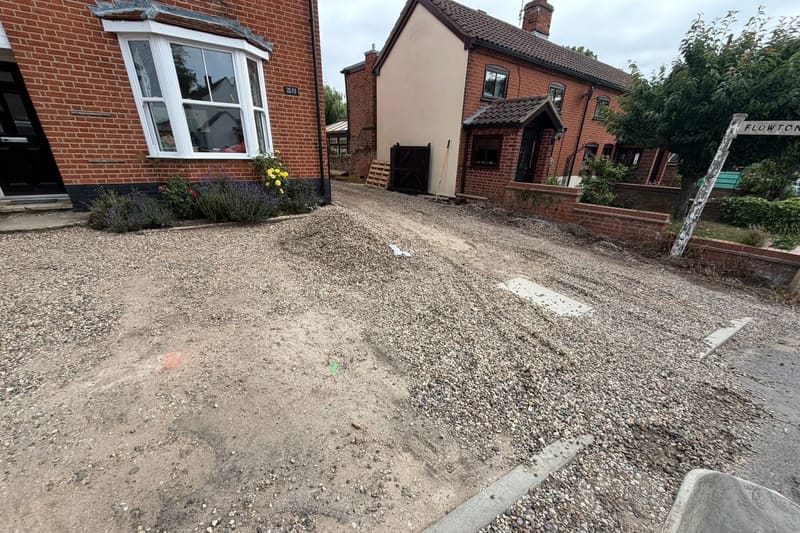
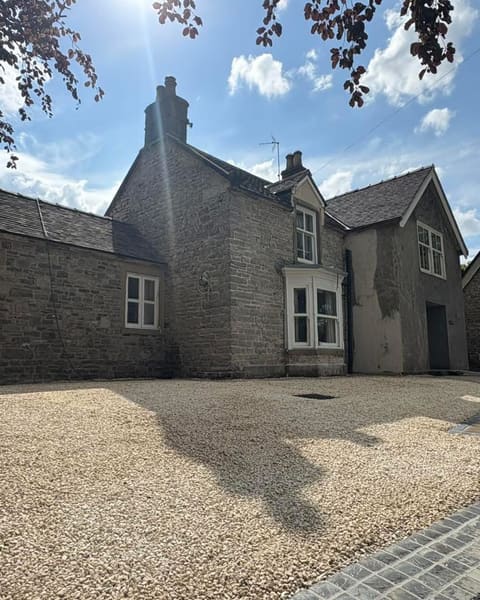
Worn tarmac lifted out and replaced with gravel over a block paved edge, with a new fence line beside it.

Tarmac, gravel and block paving, with the base dug, the edges set and the levels taken before anything goes down.
Find us on









A drive carries a car, and a car is heavy in four small places. Whatever the surface is, what holds it up is the same: the soft ground dug out, a sub base of crushed stone put back and compacted in layers, and an edge set in concrete before the surface goes anywhere near it. The photograph here is that stage on a real drive: sub base in, edge course set, nothing on top yet.
The surface is the last thing to go down and the first thing to be judged. If the base under it was skipped, the surface tells you within two winters: gravel sinks into ruts, tarmac cracks along the wheel lines, blocks tip at the edge.
Every drive needs something holding its edge, or it spreads. On a gravel drive that is a block or a kerb set in concrete. On tarmac it is a kerb or an edge course. On block paving it is the edge course itself, haunched in concrete before the rest is laid.
We take the levels before we dig, so the finished drive falls away from the house and towards somewhere the water can go. A drive that falls towards the front door is a drive that floods the porch.
Each one is the right answer for somebody. This is what each one asks of you afterwards, what it needs at the road, and what it does with rain.
| Surface | Maintenance | At the road edge | Drainage |
|---|---|---|---|
| Gravel | Rake it back where the tyres push it, top it up every few years, pull the odd weed. It shows tyre marks and it hides oil. | Needs a solid edge or a kerb, or it migrates onto the pavement. A tarmac apron at the road keeps it off the highway. | Water goes straight through it. What happens next depends on the base under it and the ground under that. |
| Tarmac | Very little for years. Edges can crumble without a restraint. Oil marks stay. Weeds get in along cracks if it is left. | Needs a proper apron and a kerb, laid to the same level as the pavement crossing. | Sheds water. It needs somewhere for the water to go: a channel drain, a soakaway, a lawn or border. Not the pavement. |
| Block paving | Weeds in the joints, re-sanding, the occasional lifted block reset. It is the easiest surface to repair a patch of. | The edge course is set in concrete first, so the field of blocks has something to push against. | Standard block sheds water like tarmac. Permeable block lets it through, if the base under it is built for that. |
The rules that came in during 2008 say that if you pave more than five square metres of front garden with a surface that sheds water, the water has to be dealt with: either the surface is permeable, or it drains to a lawn, a border or a soakaway inside your boundary. Gravel and permeable block do the first. Tarmac and standard block do not on their own, so on those we build the drainage in and say what we are doing on the quote. We do not tell you a surface does something it does not.
Before in the corner, as always.
Worn tarmac lifted out and replaced with gravel over a block paved edge, with a new fence line beside it.

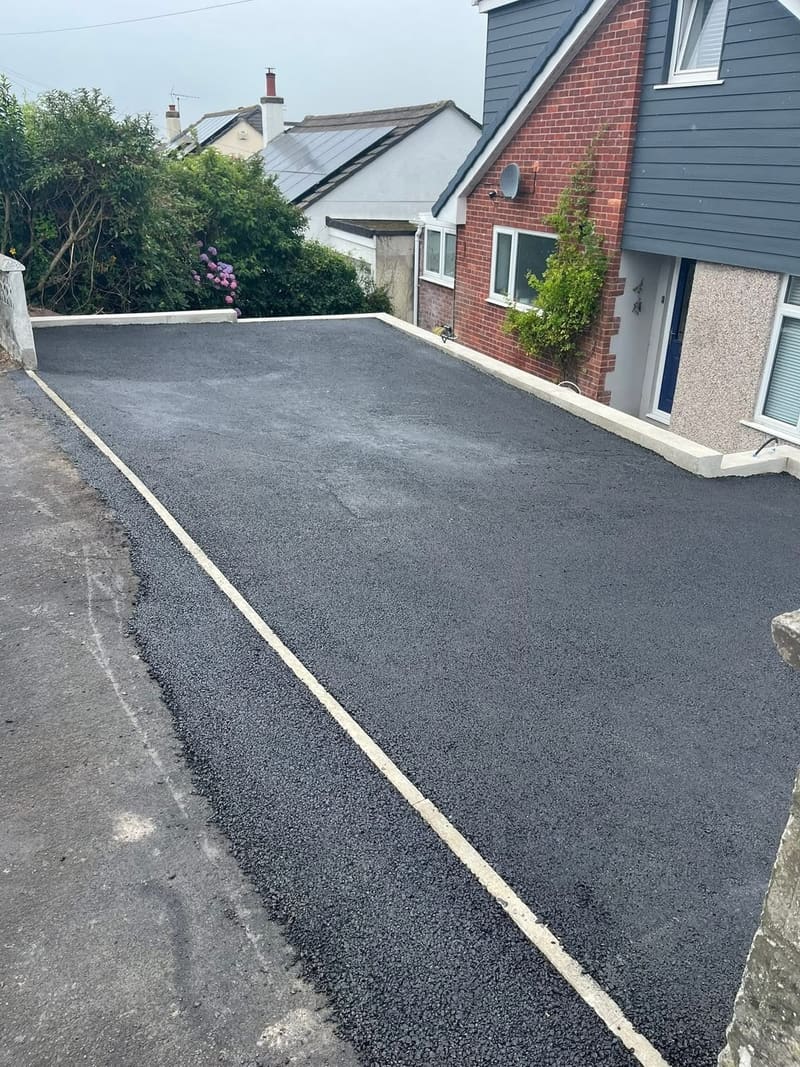
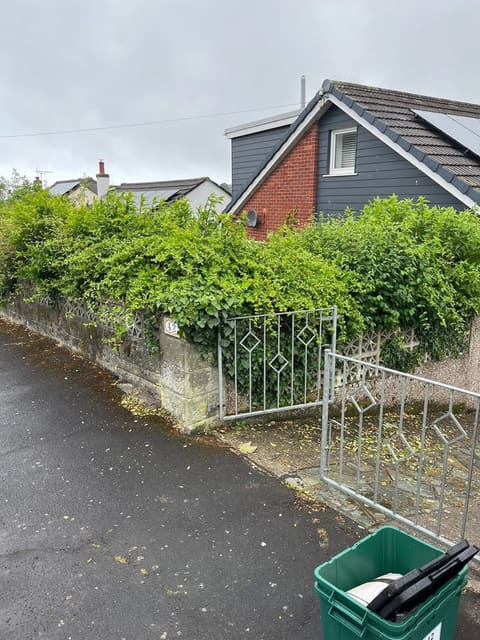
Worn tarmac out, a new rendered retaining wall built along one side, and fresh tarmac laid up to the door.
Driveways in Orpington, Sevenoaks, Biggin Hill, Brasted, Westerham, Oxted and Knockholt, and the area around them. Where we work.
Tell us what the job is and roughly where it is. We will come and look at it.
0800 193 4212Freephone07925 068877Mobile aceandsonss@gmail.com
Orpington, Kent, and the area around it.